
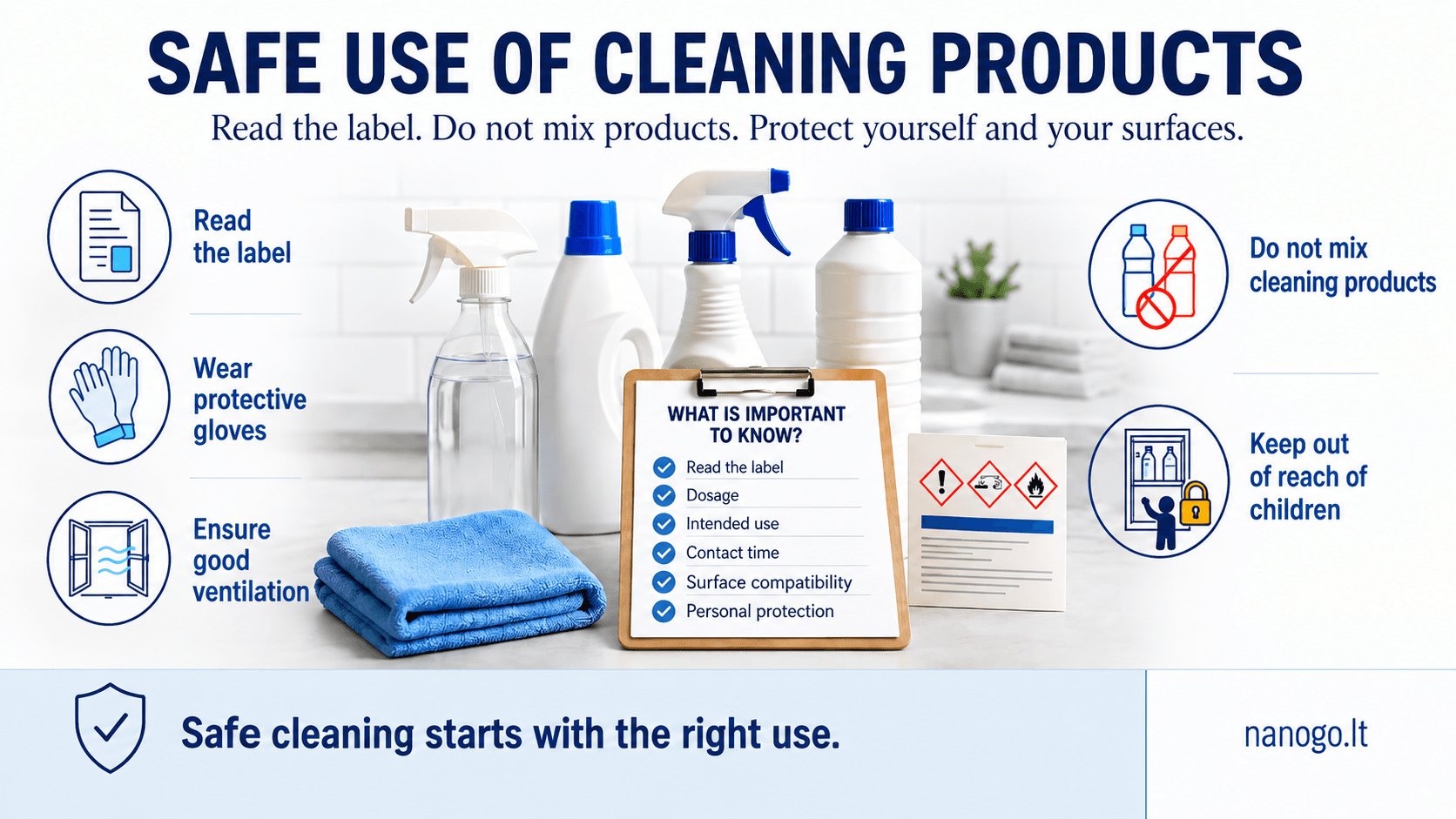
Safe Use of Cleaning Products
Good cleaning does not start with the strongest cleaner. First, it helps to understand what you are cleaning, what type of dirt you want to remove and whether the chosen product is suitable for that surface. The label is not just a formality – it is a short guide to using the product in the way it was designed to be used.
In the kitchen we deal with grease and burnt-on deposits, in the bathroom with limescale and soap residue, on glass with water marks, and on textiles with completely different types of dirt. There is no single universal cleaner that is equally suitable for all of these jobs.
Before cleaning, it is worth answering three simple questions: what do I want to remove, what surface am I cleaning, and how should this product be used? Once you know the answers, most of the job is already clear.
A simple rule: when using a product for the first time, read its label. Even two cleaners that look similar may have different purposes, contact times and surface restrictions.
Where should you start before cleaning?
A common mistake is to pick up a bottle first and only then wonder whether it is suitable. It is easier to do it the other way round.
What type of dirt is it?
Grease, limescale, soap residue, soot, rust, textile stains and everyday dust are not the same cleaning problem.
What is the surface?
Glass, stainless steel, aluminium, natural stone, plastics, textiles and lacquered surfaces react differently to cleaning chemistry.
What do the instructions say?
The product itself is only part of the answer. Contact time, quantity, rinsing and other conditions of use also matter.
Should you test first?
If the surface is delicate, old, painted, matt or its finish is unclear, test the product on a small inconspicuous area first.
A stronger cleaner is not automatically a better cleaner. If a milder product is enough for routine care, there is little reason to use an intensive cleaner every time.
The opposite is also true. Spending hours scrubbing burnt-on grease with a product that is simply too mild can waste both time and effort.
Dirt and surface – two different questions
A cleaner must suit both the dirt and the surface. The fact that a product dissolves limescale or grease effectively does not mean that it can be used on every material.
| Problem | What are we looking for? | What else should we check? |
|---|---|---|
| Limescale | A product designed to dissolve mineral deposits. | Whether the surface is resistant to the acidic formulation. |
| Grease and burnt-on deposits | A formulation designed for degreasing and burnt-on dirt. | Compatibility with the metal, paint, lacquer or other coating. |
| Marks on glass | A product chosen according to the cause of the marks – limescale removal or routine glass cleaning. | Whether the glass has a special coating or film. |
| Textile stains | A cleaning product intended for textiles. | Colour fastness and the manufacturer’s care instructions. |
The aim is not to find the “strongest” product. The aim is to find the right product for the specific job.
What should you read on the label?
A cleaning product label can contain quite a lot of information, but consumers do not need to memorise all of it. In practice, a few parts are especially useful.
| On the label | What does it tell you? |
|---|---|
| Intended use | What types of dirt and surfaces the product is designed for. |
| Directions for use | How much to use, how long to leave it to work, whether agitation is needed and whether rinsing is required. |
| Surface restrictions | Where the product should not be used or where testing should be carried out first. |
| CLP information | If the mixture is classified as hazardous, the label identifies its hazardous properties and precautionary measures. |
| UFI | Helps poison centre professionals identify the exact mixture. |
| Supplier details | Who is responsible for placing the product on the market and where further information can be obtained. |
Sometimes the most useful sentence on a label is not beside a hazard pictogram at all. It may simply say: “do not allow the product to dry”, “do not use on hot surfaces” or “test on an inconspicuous area first”.
Hazard and risk are not the same thing
These two words are often treated as if they mean the same thing, although they describe different concepts.
A hazard describes a property of a product or one of its ingredients. For example, a mixture may irritate the eyes, be flammable or affect certain metals.
Risk depends on how the product is used: the amount involved, concentration, exposure, contact time and whether the instructions are followed.
A pictogram is not a product quality rating. It does not tell you whether a cleaner is good or bad. It tells you which property needs attention and which precautions should be followed.
The reverse is also true. If a product does not carry a red CLP diamond, this does not mean it can be used anywhere and in any way. Surface compatibility and directions for use still matter.
How to understand CLP labelling
CLP is the European Union system for the classification, labelling and packaging of chemical substances and mixtures. If a product meets the criteria for classification as hazardous, standardised information is provided on its label.
In practice, you may see a hazard pictogram, a signal word, H and P statements and, where applicable, additional EUH information.
Pictograms
Different NANO GO products may carry different CLP pictograms depending on the formulation. It is important not only to recognise the symbol but also to read the wording beside it.
| Symbol type | What can it indicate? |
|---|---|
| Exclamation mark | For example, eye or skin irritation, skin sensitisation or another effect specified on the label. |
| Corrosion | Depending on the classification, serious effects on the eyes or skin, or corrosivity to metals. |
| Flame | The product or its vapours may be flammable. |
| Environmental hazard | The product may be hazardous to aquatic organisms. |
| Serious health hazard | Used for certain more serious or long-term health hazard classes. |
| Skull and crossbones | Acute toxicity. The exact nature of the hazard is stated in the relevant H statement. |
“Danger” and “Warning”
These are signal words used to indicate different levels of hazard. A label normally uses one of them according to the classification of the specific mixture.
H, P and EUH statements
H statements
Describe the hazardous property of the product. For example, that it causes eye irritation or is flammable.
P statements
Explain how to use and store the product more safely and what to do in the event of an incident.
EUH statements
Provide additional information used in the European Union where it is required for a particular product.
There is no need to memorise H and P numbers. What matters most is the wording printed beside them on the label.
What is a UFI and why is it useful?
UFI stands for Unique Formula Identifier. It is a 16-character alphanumeric code shown on the label after UFI:.
Its purpose is very practical. If professional advice is needed after an incident involving a chemical product, the UFI helps poison centre professionals link the package to information about the exact mixture.
A UFI is not a hazard rating. A longer or more complicated-looking code does not mean a stronger product. It is simply an identifier for a particular mixture.
This is why it is useful to keep the product package available in the event of an incident. It contains the UFI, product name and other information that may help professionals identify the mixture.
How to use a cleaning product correctly
A good result often depends less on how much product is sprayed and more on whether it is used in the way it was designed to work.
Use only as much as needed
A thicker layer does not always clean better. Excess product may take longer to rinse and can leave residue or streaks on some surfaces.
Give the product time to work
A cleaner often needs a few minutes to soften or dissolve dirt. There is no need to start scrubbing hard immediately.
Do not allow it to dry if instructed
With more intensive cleaners in particular, respect the stated contact time and do not leave the product on the surface longer than necessary.
Rinse when required
If the instructions say to rinse with water, rinsing is part of the cleaning process, not an optional final step.
A few more simple rules
- ensure normal ventilation when using spray cleaners indoors;
- avoid unnecessary spraying into the air – the product is intended for the surface;
- if the label tells you to wear gloves or eye protection, do so;
- before cleaning a hot oven or another heated surface, check the product instructions;
- use a suitable cloth, sponge or brush – sometimes the wrong tool can damage the surface faster than the cleaner itself.
Can different cleaners be mixed?
The simplest answer is: do not mix different cleaning products unless the manufacturer clearly states that they are intended to be used together.
Each formulation is designed to work under particular conditions. Mixing two products can change their pH, reduce cleaning performance, damage the surface or cause an unwanted chemical reaction.
There is no need to experiment. If one product has not done the job, rinse and remove it according to the instructions and only then, if necessary, use another suitable product.
Be particularly careful with internet cleaning recipes that suggest mixing several household products simply because “it will work stronger”. In chemistry, stronger does not necessarily mean better.
How to avoid damaging the surface
People often think about protecting their hands but forget the other side of cleaning safety – the surface itself. Even a good cleaner can be unsuitable for a particular material.
Natural stone
Marble, travertine, limestone and other acid-sensitive mineral surfaces can be damaged by acidic cleaners. If you do not know what type of stone you have, identify it before cleaning.
Unprotected metals
Aluminium, copper, brass, zinc and other metals can react differently to different formulations. Check the information for the specific product and, where use is permitted, test a small area first.
Painted, lacquered and anodised surfaces
The finish can matter just as much as the underlying material. Two metal surfaces that look almost identical may have completely different coatings.
Plastics and acrylic
Different plastics have different resistance to solvents, acids and alkalis. An unfamiliar surface should always be tested in an inconspicuous area first.
Textiles and leather
Check not only the cleaning result but also any change in colour. Testing on an inconspicuous area is particularly useful here.
If you do not know what the surface is made from or how it has been finished, do not guess. Test a small area first.
How should cleaning products be stored?
This does not need to be complicated. A few good habits prevent most avoidable problems.
- keep products in their original labelled packaging;
- do not transfer cleaners into food or drink containers;
- keep them out of reach of children;
- follow the storage temperature stated on the label;
- protect from direct sunlight and heat where instructed;
- close the packaging properly after use;
- do not use a product if the package is damaged to the point that it can no longer be safely closed or identified.
The original packaging matters for more than appearance. It keeps the product name, directions, UFI, warnings and contact information together with the product.
What should you do if something goes wrong?
First, check the label of the specific product. Its P statements give instructions based on the classification of that particular mixture.
In the eyes
Rinse carefully with water and follow the instructions on the product label. If contact lenses are present and easy to remove, remove them.
On the skin
Remove product residue and follow the washing and other instructions given on the label.
Product swallowed
Do not experiment with “neutralising” it using another chemical product. Keep the package available and follow the information given on the label.
Feeling unwell after inhalation
Stop using the product, move to fresh air and follow the instructions on the label.
In Lithuania, specialists at the Poison Information Bureau provide advice by telephone at +370 5 236 20 52. If there is an immediate threat to life or health, call 112.
When seeking advice about a product, it is useful to have the packaging with you. The product name and UFI can help identify the mixture more quickly.
Cleaner, nano coating or biocidal product?
A lot of confusion disappears once different product purposes are separated from one another.
| Product type | Main job |
|---|---|
| Cleaner | Remove dirt such as grease, limescale, stains, soot or other contamination. |
| Surface-care product | Help maintain the appearance or particular properties of a surface. |
| Nano coating | Modify surface properties or form a very thin functional protective layer. |
| Biocidal product | Control harmful organisms through the action of an active substance under the rules applicable to biocidal products. |
The word “nano”, the presence of nanosilver in a formulation or a pleasant fragrance does not automatically turn a cleaner into a disinfectant. Product claims must match its actual legal and technical status.
Read more: Nano Coatings and Nanosilver in Cleaning Products .
Labels, product pages and digital information
There will always be less space on a bottle than on a website. A product page or information accessed through a QR code can therefore explain much more: suitable surfaces, directions for use, frequently asked questions, ingredients, technical documents and other information.
Digital information does not remove information that legislation requires to appear on the physical packaging.
| Where should you look? | What information is most useful there? |
|---|---|
| Label | Intended use, directions, required warnings, CLP information, UFI and supplier details. |
| Product page | More detailed directions, suitable surfaces, practical advice and FAQs. |
| Digital product information | Extended ingredient, technical, safety and other product-specific information. |
| Safety Data Sheet | Detailed information for professional and supply-chain use concerning the properties of the mixture, safety, storage, transport and actions in the event of an incident. |
EU detergent rules are also changing
In 2026, the European Union adopted Regulation (EU) 2026/405 on detergents and surfactants. Most of its provisions will apply from 23 September 2029, when the current Regulation (EC) No 648/2004 will be replaced by the new system.
The new regulatory framework also provides for the use of a digital product passport. Until then, transitional rules apply, so the labelling of a particular product must always be considered according to when it was placed on the market and which requirements applied at that time.
Digital information is useful not because it replaces the label, but because it allows consumers to access more information in one place.
Frequently asked questions
Is a cleaner with a hazard pictogram unsafe to use at home?
A pictogram identifies a specific hazardous property of the product. It does not mean that the product cannot be used. Follow the label instructions, use the correct amount and use any stated protective measures.
If there is no hazard pictogram, can the cleaner be used on any surface?
No. CLP classification and surface compatibility are different issues. Even a non-classified cleaner may be unsuitable for a particular stone, metal, plastic, painted or lacquered surface.
Does using more cleaner give a better result?
Usually not. The right formulation, sufficient contact time and the correct cleaning method are more important. Too much product may simply make rinsing more difficult.
Can I use one cleaner immediately after another?
Do not mix different cleaners. If you need to change product, first remove and rinse the previous cleaner according to its directions for use.
What is a UFI code used for?
A UFI helps poison centre professionals link a specific product to information about its mixture. This is why it is useful to keep the packaging available in the event of an incident.
Does every household user need to read the SDS?
For normal consumer use, the main information should be available on the label and in the product instructions. The SDS is a much more detailed technical document, particularly important for professional use, workplaces and the supply chain.
Is a “natural” cleaner automatically safer?
No. Product safety depends on the actual substances, concentration, method of use and complete formulation, not simply on the origin of an ingredient. Read more in Eco Cleaner or Green Marketing?
Official sources and further information
- EUR-Lex – CLP Regulation: classification and labelling
- ECHA – CLP labelling and packaging
- ECHA – CLP pictograms
- ECHA – why the UFI matters
- Detergents Europe – A.I.S.E. safe-use icons
- EUR-Lex – Regulation (EC) No 648/2004 on detergents
- EUR-Lex – Regulation (EU) 2026/405 on detergents and surfactants
- ECHA – understanding the Biocidal Products Regulation
- Lithuania – Emergency Response Centre, number 112
Choose according to the actual cleaning job
NANO GO product pages explain their intended use, suitable surfaces, directions and the most important restrictions. A cleaner should help you do the job, not make you guess what it can be used for.
Explore NANO GO products