
Nanosilver in Cleaning Products
The word “nanosilver” sounds much more complicated than the basic idea. It refers to very small silver particles whose properties can differ from those of larger forms of silver. Nanosilver is used and studied in medicine, textiles, coatings, filtration systems and other fields, and it may also be used as one of the ingredients in cleaning and surface-care products.
It is important to make one distinction from the start. Nanosilver is not a cleaner on its own, and it does not remove grease, limescale or burnt-on deposits by itself. The performance of the final product comes from the complete formulation.
So this article is not about presenting nanosilver as a miracle ingredient or making it sound more alarming than it is. We will look at it practically: what it is, why nanoscale matters, what scientific research shows and what this means for someone choosing a cleaning product.
What is nanosilver?
Nanosilver is a general term for very small silver particles or silver-containing nanostructures. Their dimensions are measured in nanometres.
One nanometre is one billionth of a metre. That scale is difficult to picture in everyday terms, so there is a more practical point to understand: when particles become very small, their surface area becomes much larger in relation to their mass.
Under the European Commission’s 2022 recommendation on the definition of nanomaterial, a material is essentially considered a nanomaterial when 50% or more of the particles in the number-based size distribution have one or more external dimensions in the 1-100 nm size range. Additional or specific provisions may apply to particular product groups under individual pieces of legislation.
Size
Smaller particles have a larger relative surface area and may therefore interact more actively with their surroundings.
Shape
Particles with different shapes can have different physical and chemical properties.
Surface
Surface coatings and stabilisation methods can affect how the particles are distributed, how stable they remain and how they interact with their surroundings.
Medium
The same particle may behave differently in water, in a cleaning formulation or in another surrounding medium.
Why does such a small size change the properties of silver?
Consider a simple comparison. A solid piece of silver and millions of very small silver particles may contain a similar total mass of silver, but the amount of surface directly exposed to the surrounding environment will be very different.
This is why properties that are much less noticeable in a larger piece of silver can become important at the nanoscale. Particle reactivity, the release of ions, optical properties and interactions with surrounding materials can all change.
A nanoform is therefore not simply “the same silver, only smaller”. At the same time, the word “nano” does not automatically mean that a product is better or worse. It describes scale and the properties associated with that scale.
“Nano” is not a quality mark. It is a technological description. Product quality still depends on the complete formulation and whether it performs the job it was designed to do.
How does nanosilver interact with microorganisms?
The interaction between silver, silver nanoparticles and microorganisms has been studied for many years. Scientific research commonly discusses several related mechanisms.
Silver ions
Silver nanoparticles can release silver ions. These are considered an important part of the effects on microorganisms observed in research.
Cell membranes
Studies have observed interactions with microbial cell membranes that can interfere with their normal function.
Proteins and enzymes
Silver ions can interact with proteins and enzymes that microorganisms need for normal biological functions.
Oxidative stress
Another area of research involves the formation of reactive oxygen species and changes in the oxidative balance within cells.
There is no single universal mechanism that works in exactly the same way in every situation. Results depend on particle size, shape, surface properties, concentration, surrounding medium, type of microorganism and contact time.
This is why a laboratory study involving a particular type of silver nanoparticle does not automatically prove that every finished product labelled “with nanosilver” will perform in the same way.
What does nanosilver mean in a cleaning product?
This is the most important practical part.
A cleaning product may contain many different components. Some help wet the surface, others help separate grease, dissolve mineral deposits, stabilise the formulation or perform another specific function. Nanosilver can be one of these functional ingredients.
But if the job is to remove limescale, the main work still has to be done by a formulation designed for mineral deposits. If the job is to remove burnt-on grease, nanosilver does not replace a suitable degreaser.
Put simply: nanosilver can be a technological part of the formulation, but good cleaning performance has to come from the complete product, not from one impressive-sounding ingredient.
This is why “does it contain nanosilver?” is not the most important question when assessing a cleaner. It is more useful to ask what the product is designed for, what type of dirt it removes, which surfaces it is suitable for and how it should be used.
Is a cleaner containing nanosilver a disinfectant?
Not necessarily.
A cleaner and a biocidal product are not the same thing. The main purpose of a cleaner is to remove dirt. The purpose of a biocidal product is to control harmful organisms through the action of an active substance.
The simple fact that a formulation contains nanosilver does not automatically allow the finished product to be described as a disinfectant or to claim that it “kills bacteria”, “disinfects” or “protects against viruses”.
Such claims must be consistent with the intended purpose of the specific product, its efficacy data and its regulatory status under the rules applying to biocidal products.
The properties of an ingredient and a claim made for the finished product are not the same thing. This is one of the most important rules when assessing cleaning products.
Does more nanosilver mean a better product?
No. A formulation is not a recipe where simply adding more of one ingredient automatically produces a better result.
The amount of a functional ingredient has to work with the complete system. An excessive concentration can affect particle stability, interactions between particles, the appearance of the product and other properties of the formulation.
The aim of a well-designed product is not to add as much nanosilver as possible. The aim is to use an appropriate amount and form for a justified purpose within the particular formulation.
Where else is nanosilver used?
Silver nanoparticles are used or studied in many different fields. Their exact purpose depends on the product and application.
- medical materials and some wound-care products;
- medical-device and other specialist coatings;
- textiles;
- polymers and composite materials;
- some filtration systems;
- surface coatings and technical formulations;
- cleaning and surface-care products as one of the functional ingredients.
This does not mean that exactly the same nanosilver is used in all these applications or that the same requirements apply to each of them. Nanoforms can differ in size, surface properties, stabilisation and other characteristics.
Is nanosilver the same as a nano coating?
No. They are two different things.
Nanosilver is a nanoform of silver. A nano coating is a surface-treatment system designed to change particular surface properties or form a very thin functional layer.
Nanosilver may theoretically be one component in some coatings, but it is not required for a nano coating. Many hydrophobic, ceramic and other functional coatings have nothing to do with nanosilver.
In the same way, a cleaning product containing nanosilver does not necessarily leave a nano coating on the cleaned surface.
Read more: Nano Coatings
How is nanosilver safety assessed?
There is no single answer of “safe” or “unsafe” that applies to every nanoform and every type of use.
Safety assessment considers the specific material and the specific use scenario: particle size, surface properties, concentration, product form, possible routes of exposure and the complete finished formulation.
Skin contact
Assessment considers the actual product formulation, concentration and method of use, not simply the word “nanosilver”.
Spray products
The spray method matters because fine droplets may be generated during use. Spray products should be used according to their label instructions.
The complete formulation
The classification of the finished cleaner may be determined by other ingredients such as acids, alkalis or solvents.
Real conditions of use
The amount used, the surface, the surrounding environment and the duration of contact all matter.
In 2014, the European Commission’s Scientific Committee on Emerging and Newly Identified Health Risks, SCENIHR, published a detailed assessment of nanosilver covering human health, environmental effects and the possible development of microbial resistance. It emphasised that risk cannot be assessed from the material name alone and that additional data were needed for some long-term and widespread uses.
Consumers do not need to determine product safety themselves simply because the word “nano” appears on the front of a package. Follow the label, intended use and directions for the specific product.
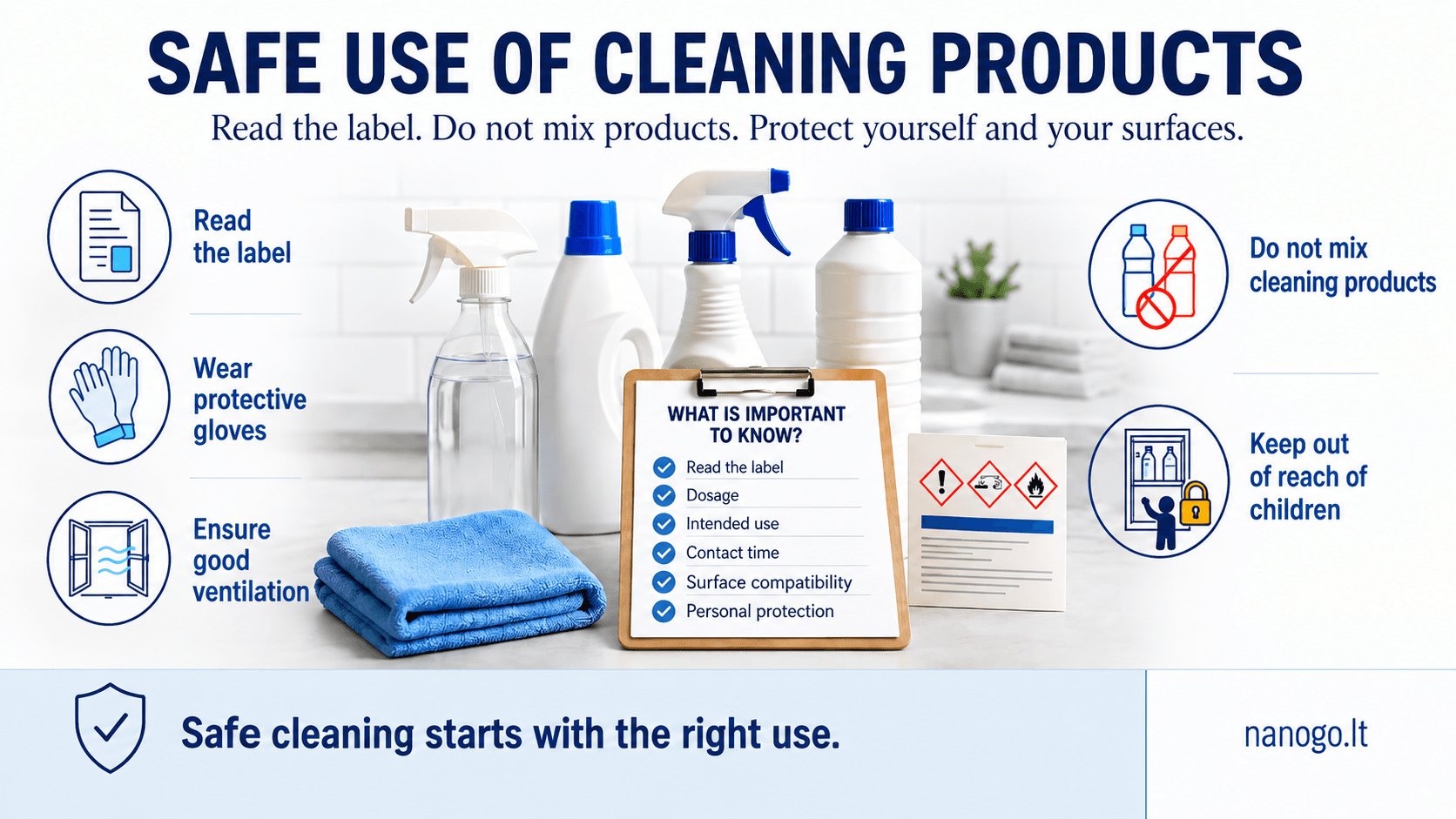
For more on labels, CLP and the safe use of cleaning products, see: Safe Use of Cleaning Products .
What should you know about environmental impact?
Silver is biologically active, so discussions about the environmental impact of nanosilver need to consider not only what it does in a product but also what happens to it after use.
Researchers study the distribution of nanosilver and silver released from it in wastewater, sewage sludge, soil and aquatic environments. The outcome depends on particle form, concentration and chemical transformations in the environment.
This is another reason why the idea that “if a little is useful, more must be even better” does not apply here. Functional ingredients should be used deliberately and in justified amounts.
How are nanomaterials regulated in the European Union?
The European Union does not have one separate “nano product regulation” that applies in exactly the same way to every product. Requirements depend on the material, the product category and its intended use.
REACH and CLP
Nanomaterials fall within the EU REACH and CLP chemicals regulatory framework. Since 2020, REACH has included additional information requirements for companies manufacturing or importing nanoforms of substances that are subject to registration.
These requirements cover the characterisation of nanoforms, information about their properties and data needed for safety assessment.
Biocidal products
The EU Biocidal Products Regulation contains additional specific provisions for nanomaterials.
Approval of an active substance does not automatically cover its nanoform unless this is explicitly stated. Where nanomaterials are used in a biocidal product, a separate risk assessment is required, and the name of the nanomaterial must be followed by the word “nano” in brackets on the product label.
The practical conclusion is simple: a product’s regulatory status depends on what the product is, what it is intended to do and what claims are made for it. The presence of nanosilver alone does not determine that status.
How should you assess a product containing nanosilver?
Instead of asking “does it contain nano?”, it is more useful to ask a few simpler questions.
What is the product actually designed for?
Is it a bathroom cleaner, textile-care product, everyday maintenance product, coating or a formulation for another purpose?
What actually does the cleaning?
A good product should not hide the purpose of the complete formulation behind one fashionable ingredient.
Is the product suitable for my surface?
Nanosilver does not override the compatibility rules that apply to acids, alkalis, solvents and other ingredients in the formulation.
Are the claims specific?
The more precise the claim and the clearer the product’s intended use, the easier it is to understand what you are actually paying for.
The NANO GO approach is simple: technology should have a clear purpose. If a product’s strength lies in a good formulation designed for a particular surface and cleaning task, there is no reason to reduce everything to the single word “nano”.
Frequently asked questions about nanosilver
What is nanosilver?
Nanosilver is a general term for very small silver particles or silver-containing nanostructures. Their properties depend not only on size, but also on shape, surface characteristics, stabilisation and the environment in which they are used.
Does nanosilver clean a surface by itself?
No. Grease, limescale, soap residue and other contamination have to be removed by a cleaning formulation designed for the specific job. Nanosilver may be one functional component of that formulation.
Is a cleaner containing nanosilver a disinfectant?
Not necessarily. Cleaners and biocidal products are different product categories. The presence of nanosilver alone does not turn the finished product into a disinfectant.
Is nanosilver the same as colloidal silver?
A colloid is a system in which very small particles are dispersed in another medium, such as a liquid. If the silver particles in that colloid are nanoscale, it may be described as a nanosilver colloid. However, the word “colloidal” alone does not define the exact particle size or product properties.
Does more nanosilver mean a stronger product?
No. The final result depends on the complete formulation, and the amount of a functional ingredient should be justified and balanced with the other components of the product.
Do nano coatings always contain nanosilver?
No. Nano coating and nanosilver are not synonyms. Many hydrophobic, ceramic and other nano coatings contain no nanosilver.
Does the word “nano” mean that a product is hazardous?
No. “Nano” describes the scale of a material or structure, not a hazard class. Product safety is assessed according to the actual formulation, nanoform, concentration, method of use and potential routes of exposure.
Official and scientific sources
- European Commission Recommendation 2022/C 229/01 on the definition of nanomaterial
- ECHA – nanomaterials under REACH and CLP
- ECHA / EUON – nanoforms under REACH and CLP
- ECHA – nanomaterials under the Biocidal Products Regulation
- Regulation (EU) No 528/2012 concerning biocidal products
- European Commission / SCENIHR – nanosilver: safety, health and environmental effects
- Rodrigues et al., 2024 – review of antimicrobial mechanisms of silver nanoparticles
Technology should have a clear purpose
Choose NANO GO products first according to the surface and the cleaning task. Nanosilver can be a valuable part of a formulation, but good results always depend on using the right product in the right way.
Explore NANO GO products