
Nano coating
Nano Coating: Invisible Protection That Changes the Way We Think About Cleanliness and Longevity
From the broom to the nanoparticle
Today, the concept of cleanliness has taken on a new meaning. While basic cleaning used to be enough, we now speak more and more about protecting surfaces and preserving their properties over the long term.
Technologies that sounded like promises of the future just a couple of decades ago are now available in every home. One of them is nano coating.
Although the name sounds scientific, the idea is simple: it is a very thin layer that creates a protective barrier between our environment and the surface itself. It is almost invisible, yet it can dramatically change how long furniture, cars, windows, or even clothing stay clean.
What lies behind the word “nano”?
The word “nano” refers to an extremely small scale – one nanometer is one billionth of a meter. Nano coatings are made of microscopic particles that fill even the smallest surface irregularities. As a result, they form a continuous film capable of repelling water, oil, dust, and other contaminants.
These coatings are often called hydrophobic or oleophobic. This means that when liquid lands on the surface, it no longer soaks in – it simply forms droplets and rolls off.
This effect can be compared to raindrops on a lotus leaf, where water simply cannot cling to the surface.
Why is nano coating used so widely?
Nano coatings can be used almost anywhere surfaces need protection from dirt, moisture, oxidation, or wear. This technology is successfully applied to textiles, footwear, wood, glass, ceramics, plastics, metal, and even in automotive care.
Where is nano coating used most often?
- At home: furniture, shower enclosures, fireplace glass, kitchen countertops, sinks, and tiles.
- On textiles: curtains, sofa upholstery, carpets, sportswear, and outdoor clothing.
- In cars: bodywork, glass, rims, and interior upholstery.
The versatility of nano coating comes from the fact that it can be adapted to materials of different compositions. Some formulas are water-based, while others are based on silicon or titanium dioxide. They can be colorless, odorless, and almost unnoticeable.
The main benefits of nano coating
1. Protection from dirt and liquids
One of the most obvious benefits is that surfaces become more resistant to stains. Spilled coffee or wine on textiles does not necessarily leave a mark if the fabric is protected with nano coating. Limescale no longer builds up as easily on glass or ceramics, and dirt is less likely to stick to a car’s bodywork.
2. Easier maintenance
Nano coating does not eliminate the need for cleaning entirely, but it makes the process significantly easier. Dirt does not penetrate deeply, so a stream of water or a damp cloth is often enough. This is not only convenient, but also reduces the need for harsh chemical cleaners.
3. Longer surface lifespan
The protective layer reduces contact with moisture, ultraviolet rays, and chemical compounds, helping surfaces stay like new for longer. Wooden furniture is less likely to swell, metal is less likely to rust, and glass is less prone to wear.
4. Aesthetic effect
Nano coating does not create an intense shine or color, but it helps preserve the cleanliness and natural appearance of the surface for longer. This matters both in interiors and in cars, where every detail should look neat and well maintained.
5. A more environmentally friendly solution
Modern coatings are often developed with lower levels of volatile organic compounds, making them safer for indoor use. In addition, the need for frequent washing and strong cleaners is reduced, which directly contributes to lower chemical pollution.
Is nano coating suitable for all surfaces?
In theory, yes. In practice, the conditions must be assessed. The effectiveness of the coating depends on how well the surface has been prepared. It must be completely clean, degreased, and dry. Only then can the nanoparticles bond properly and create a uniform layer.
In some cases, the coating needs to be renewed after several months or years, depending on the intensity of use. On car bodywork or shower glass, it wears out faster than on fabrics because it is more frequently exposed to mechanical stress, temperature fluctuations, or cleaning agents.
Myths and reality
Myth 1: “Once nano coating is applied, the surface no longer needs cleaning.”
Reality: It still needs to be cleaned, but dirt adheres much more weakly and is far easier to remove.
Myth 2: “It is a chemically dangerous substance.”
Reality: Modern coatings are often developed in line with strict safety standards, and many of them are free from strong solvents or chlorine.
Myth 3: “One application lasts a lifetime.”
Reality: Even the most advanced coating is not permanent. It wears down over time and must be renewed periodically.
The scientific basis of nano coating
The effectiveness of nano coating is based on the concept of surface energy. The lower the surface energy, the harder it is for water or oil to “stick.” Nanoparticles form a layer that reduces contact between the surface and the liquid.
This phenomenon is often explained by the contact angle – the larger it is, the better the hydrophobicity.
For example, on uncoated glass, a drop of water spreads out, while on nano-coated glass, it forms into a bead. It is precisely because of this property that such surfaces are often considered easier to maintain.
Where does the long-term value lie?
- Less time and money spent on maintenance
- Items retain their aesthetic appearance for longer
- Less need for harsh chemical cleaners
- Longer lifespan of materials
- Easier to maintain a cleaner environment
This is especially relevant in today’s world, where sustainability, health, and saving time have become some of the most important priorities in everyday life.
When is it worth investing in nano coating?
If you have small children or pets, nano coating can become a real lifesaver against everyday stains. If your car or furniture is made from expensive materials, it can be an excellent way to protect them from premature wear.
For those who value minimalism and want things to look neat without major effort, this technology becomes a practical choice.
Nano coating is not a sign of luxury – it is a rational solution that helps maintain cleanliness and longevity more easily.
A look into the future
Scientists continue to improve the composition of nano coatings – developing antibacterial formulas, UV-repellent coatings, and solutions that are even more resistant to environmental impact. It is very likely that in the coming years these coatings will become even more accessible for everyday use.
It is quite possible that nano technologies will soon become as common in the household as ordinary cleaning products are today. The difference is that in this case, the effect of cleanliness is achieved not only through intensive chemistry, but through advanced surface physics.
Conclusion
Nano coating is more than a fashionable trend. It is scientific progress that can be applied in everyday life. It does not create miracles, but it makes long-lasting protection and easier maintenance possible without excessive chemistry, which is an important step toward a more convenient and sustainable way of living.
Frequently asked questions about nano coating
What is nano coating?
Nano coating is a very thin, almost invisible layer made of microscopic particles that fill surface irregularities and create a protective barrier against water, dirt, and other contaminants.
Is nano coating suitable for all surfaces?
Nano coating can be used on textiles, furniture, cars, glass, ceramics, plastic, and metal surfaces. It is important to prepare the surface properly before applying the coating.
How long does nano coating last?
The lifespan of nano coating depends on the intensity of use and the type of surface. In most cases, the coating needs to be renewed after several months or years.
Recommended products
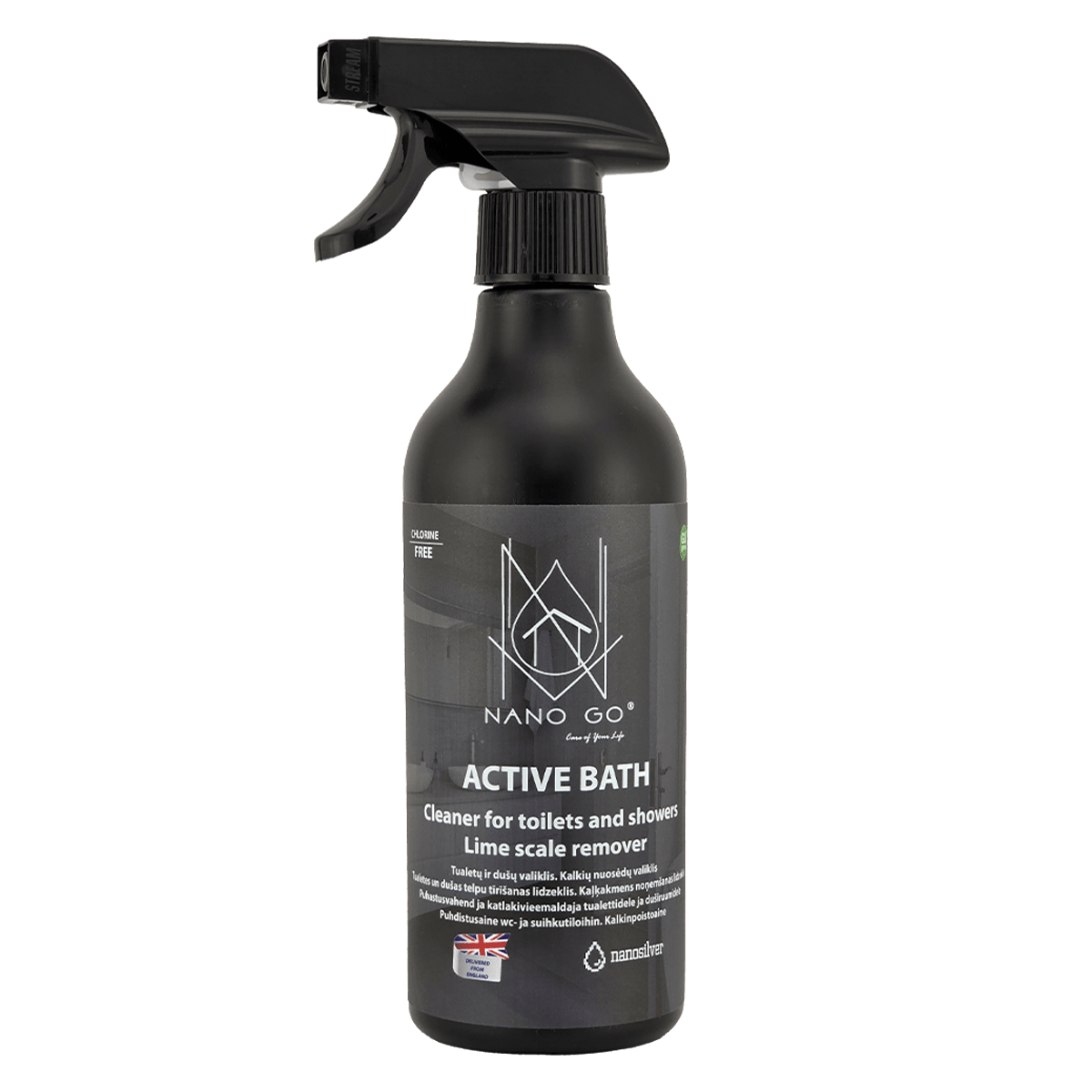
Active Bathroom Nano Cleaner 500ml
14.95€Alkaline Rust Remover
Original price was: 16.95€.13.56€Current price is: 13.56€.
Degreaser
15.95€
Glass and Glossy Surface Cleaner
14.95€
